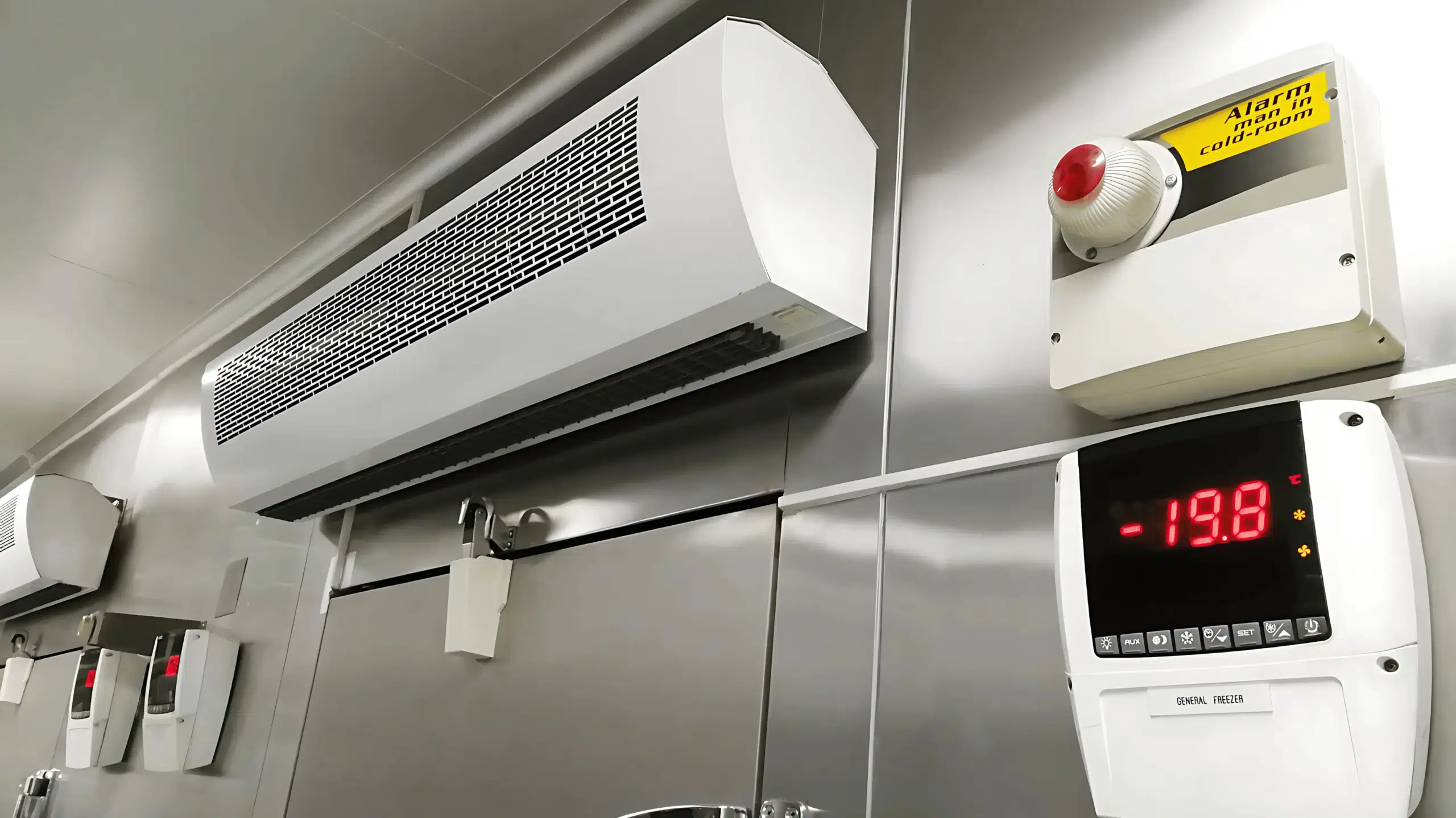
A cold room entrapment alarm, or trapped-person alarm, lets anyone shut inside a cold room or walk-in freezer call for help. It is a push button or pull cord inside the room that sets off an audible and visual alarm where someone is always present. HSE guidance says walk-in chillers and freezers must have a means of escape, with doors that open from the inside, and that your risk assessment may show trapped-person alarms are appropriate.
This guide covers what the guidance and EN 378 say, what a good alarm looks like, how it differs from a temperature alarm, and how to keep it working.
At a glance
| Question | Short answer |
|---|---|
| What it is | An alarm button or pull cord inside a cold room that raises the alarm outside |
| Is it required? | HSE requires a means of escape. A trapped-person alarm is expected where the risk assessment shows it is appropriate, which in practice covers most walk-in freezers |
| Where the alarm sounds | Somewhere a person is always present, rather than only outside the door |
| Power | EN 378 guidance calls for battery back-up of at least 10 hours on a mains charger |
| Not the same as | A temperature alarm, which warns about the stock rather than people |
Why cold rooms need it
People get shut into cold rooms more often than most businesses expect: a door blows shut, a latch fails, ice jams the internal release, or a colleague locks up at closing time without checking inside. In a freezer at -18°C or colder, that quickly becomes dangerous. Cold numbs the hands, making it harder to work a release, and hypothermia can set in.
The consequences for the business can be serious too. In 2021, a Pret a Manger employee was trapped in a walk-in freezer for two and a half hours and treated for hypothermia. Law firm Charles Russell Speechlys reported that Westminster City Council found a suitable risk assessment had not been carried out, that there had been several earlier callouts for ineffective internal push buttons, and that the company was fined £800,000 plus £23,667 in costs in 2023.
What the guidance says
The HSE's guidance on chilled and frozen food workroom temperatures says to provide means of escape following entrapment inside walk-in refrigeration units, chill units and freezers. Doors should be openable from the inside, with lighting or other means so the door and its opening device can be seen when the door is closed, and the risk assessment may show trapped-person alarms are appropriate. It points to BS 7915 for guidance on designing working practices for cold indoor environments.
The refrigeration safety standard EN 378 goes into more detail. Its informative annex on cold rooms operating below zero says it should be possible to leave a cold room at all times, with doors that open from inside and outside. For rooms over 10 m³, it lists provisions including:
- An alarm switch inside the room, such as an illuminated push button near the floor or a chain hanging near the floor, that triggers an audible and visual signal somewhere a person is always present, and that cannot be stopped except by a specific action.
- Signal devices on a circuit of at least 12 V, with batteries that last at least 10 hours on a mains charger, and a design that keeps working despite corrosion, frost or ice on the contacts.
- Lighting that can be switched on from inside and not switched off from outside, with permanently illuminated switches.
- Fans that can be switched off from inside and not restarted from outside.
- Independent lighting to show the way to the exit and alarm switch if the main lighting fails, and permanent emergency lighting.
What a good entrapment alarm looks like
- A button or pull cord inside, near the floor, so someone who has fallen or is weak from the cold can reach it.
- Clearly visible in the dark, with an illuminated button or a glow-in-the-dark sign.
- An alarm where people are, such as a staffed area or a remote monitoring system, rather than a sounder outside a door in an empty corridor.
- A latching alarm that keeps sounding until someone deliberately resets it.
- Battery back-up, so it works in a power cut.
- Built for the cold, rated for the room's temperature and protected from frost and ice.
The internal door release matters just as much. A release that ices up or a push button that sticks defeats the whole system, as the Pret case showed.
Entrapment alarm or temperature alarm?
They do different jobs, and most cold rooms need both. An entrapment alarm protects people. A temperature alarm protects the stock, warning when the room drifts out of range because of a door left open, a defrost fault or a refrigeration failure. Our guide to cold room temperature monitoring covers temperature alarms and logging, and our guide to cold room temperature rules for food businesses explains the legal limits.
Testing and maintenance
- Test the alarm regularly by pressing the button from inside, with someone outside to confirm the signal and reset it.
- Check the internal door release works freely and is not icing up, especially on freezers.
- Check the battery back-up and replace batteries as the maker says.
- Check the emergency lighting and the illuminated button or sign.
- Record the checks, and include them in your risk assessment and staff training.
- Make "check inside before locking up" part of the closing routine.
Planned refrigeration maintenance visits are a good time to check door heaters, seals and releases alongside the refrigeration. Our cold room repair engineers fit and repair entrapment alarms, door releases and heaters, and our cold room installation team builds them into new rooms.
Questions people ask about cold room entrapment alarms
Is a cold room entrapment alarm a legal requirement?
The HSE requires a means of escape from walk-in chillers and freezers, with doors that open from inside, and says the risk assessment may show a trapped-person alarm is appropriate. For walk-in freezers in particular, most risk assessments will. EN 378 guidance recommends one in sub-zero cold rooms over 10 m³.
What is a trapped-person alarm?
An alarm button or pull cord inside a cold room or freezer that sets off an audible and visual alarm in a staffed place, so anyone shut inside can call for help.
Where should a cold room alarm button be fitted?
Inside the room, near the floor so it can be reached by someone who has fallen, and near the exit. EN 378 guidance suggests an illuminated push button or a chain near the floor, and more than one in large rooms with several exits.
Does a cold room alarm need battery back-up?
Yes. EN 378 guidance calls for signal devices on at least 12 V, with batteries that last at least 10 hours and a mains charger, so the alarm still works in a power cut.
How often should an entrapment alarm be tested?
Regularly, as set by your risk assessment, and always after any work on the door or alarm. Test from inside, confirm the alarm is heard where it should be, and record it.
Can a cold room door be opened from the inside?
It must be. The HSE says doors to walk-in refrigeration units and freezers should be openable from the inside, with the release visible when the door is closed. Check it regularly for ice.
The short version
Anyone working in a walk-in chiller or freezer needs a reliable way out and a way to call for help. Make sure the door opens from inside, fit a trapped-person alarm that sounds where people are and works in a power cut, and test both as part of your routine.
Last updated: 4 November 2026

Written by
Ali Elm
Ali is the Head of Operations at Be Cool Refrigeration with over a decade of hands-on experience in HVAC and commercial refrigeration. He oversees every installation, repair, and maintenance project, making sure the work meets the highest standards. Ali holds full F-Gas certification and has worked across residential, commercial, and industrial refrigeration systems throughout London and the South East. When he is not on site, he writes these guides to help business owners and homeowners understand their cooling systems better.