On Eliwell IDPlus and UNICold controllers, E1 means the cold room probe Pb1 is faulty, short-circuited or open. The compressor then runs on a timed cycle set by the Ont and OFt parameters. E2 is a fault on the defrost probe Pb2, which only some models have, and defrosts then end on time. AH1 and AL1 are high and low temperature alarms, and they do not change how the controller runs.
The tables below come from Eliwell's own manuals for the IDPlus 902, 961, 971 and 974, the UNICold, UNIChill and UNIFreeze range, and the older ID 974 and EWPlus 974 EO.
At a glance
| Code | What Eliwell says it means | What to do first |
|---|---|---|
| E1 | Cold room probe 1 faulty | Call an engineer. The compressor runs on a timed cycle |
| E2 | Defrost probe 2 faulty | Call an engineer. Defrosts end on time |
| E3 | Probe 3 faulty | Call an engineer |
| AH1 | Alarm for high Pb1 temperature | Check the door, the load and the condenser |
| AL1 | Alarm for low Pb1 temperature | Check the set point |
| OPd | Door open alarm | Close the door |
| EA | External alarm | Find what triggered the external input |
| PAL | General pressure switch alarm, locked out | Call an engineer |
Source: Eliwell IDPlus 902/961/971/974 and UNICold, UNIChill and UNIFreeze manuals.
How Eliwell shows an alarm
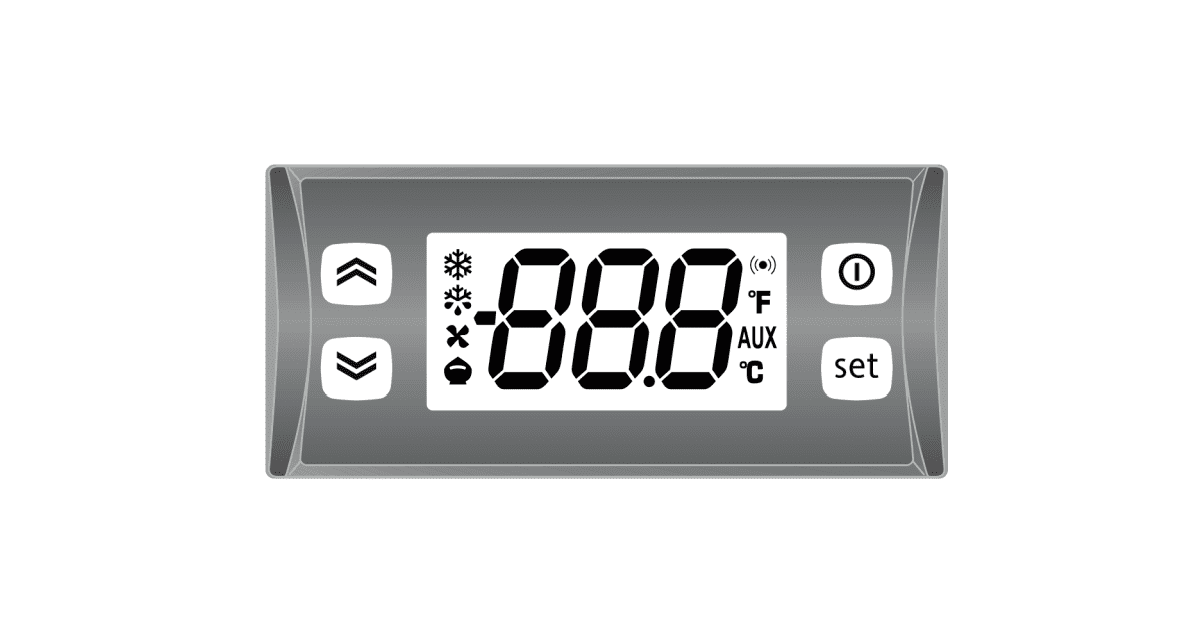
Eliwell's IDPlus manual says alarms are always shown by the buzzer, if fitted, and the alarm icon. Probe faults appear on the main display as E1, E2 or E3. Most other alarms are recorded as labels in the AL folder, so the display may show only the alarm icon and the temperature, and the code itself is found by opening that folder.
On UNICold controllers, Eliwell's UNICold, UNIChill and UNIFreeze manual says pressing the button that opens the Machine Status menu shows the AL folder when an alarm is active. If no alarms are active, the SEt label appears instead.
Pb1, Pb2 and Pb3 are the names of the probes rather than codes. Pb1 is the cold room or cabinet probe, Pb2 the defrost or evaporator probe, and Pb3 a third probe, often used on the condenser.
IDPlus alarm codes
These come from the alarm table in Eliwell's IDPlus manual, which covers the IDPlus 902, 961, 971 and 974.
| Code | What Eliwell says it means | What happens |
|---|---|---|
| E1 | Cold room probe1 faulty: probe faulty, short-circuited or open | E1 on the display, alarm icon on. Max and min alarms disabled. Compressor runs based on parameters Ont and OFt |
| E2 | Defrost probe2 faulty (IDPlus 971 and 974 only) | E2 on the display, alarm icon on. Defrost ends on timeout (dEt) |
| E3 | Probe3 faulty | E3 on the display, alarm icon on |
| AH1 | Alarm for HIGH Pb1 temperature, above HAL for longer than the set time | Recorded in the AL folder. No effect on regulation |
| AL1 | Alarm for LOW Pb1 temperature, below LAL for longer than the set time | Recorded in the AL folder. No effect on regulation |
| EA | External alarm, from a digital input | Recorded in the AL folder, alarm icon on. Regulation can be locked, depending on settings |
| OPd | Door open alarm, after the door has been open longer than the set time | Recorded in the AL folder, alarm icon on. Controller locked |
| Ad2 | Defrost due to timeout, rather than reaching the defrost end temperature | Recorded in the AL folder. Clears at the next defrost |
| COH | Over Heating alarm: Pb3 above the SA3 setting | Recorded in the AL folder. Compressor locked until the temperature falls |
| nPA | General pressure switch alarm, with the number of activations | Compressor and fans locked. Automatic reset |
| PAL | General pressure switch alarm, once the set number of activations is reached | PAL on the display. Compressor and fans locked. Manual reset |
E1 on an Eliwell controller
E1 is the most searched Eliwell code. It means the controller cannot get a valid reading from the cold room probe, because the probe is faulty, shorted or open circuit, often from a damaged cable or a loose connection. Without that reading, the controller switches off its high and low temperature alarms and runs the compressor on a fixed on and off cycle set by Ont and OFt.
The room keeps some cooling, but nothing is holding it to the set point and no temperature alarm will warn you, so check the stock with a separate thermometer until the probe is fixed. Eliwell's remedy is to check the probe type setting, check the wiring and replace the probe.
E2 on an Eliwell controller
E2 means the defrost probe has failed. Without it, the controller cannot tell when the evaporator is clear, so each defrost runs until the maximum defrost time set by dEt. The room keeps running, but defrosts may run longer or shorter than they should, which can leave ice on the evaporator. Only some models have a defrost probe: on the IDPlus range, E2 applies to the 971 and 974, and in the UNICold range, to UNIChill and UNIFreeze only.
UNICold, UNIChill and UNIFreeze codes
The UNICold range uses the same core codes. Eliwell's manual lists E1 as a Pb1 probe error on the cold room probe, E2 as a Pb2 probe error on the defrost probe, and AH1 and AL1 as Pb1 high and low temperature alarms. The effects are the same as on the IDPlus: with E1, the compressor runs on Ont and OFt, and with E2, defrosts end on timeout. A plain UNICold has no defrost probe, so it will not show E2.
Older Eliwell ID 974 and EWPlus 974 EO
The older ID 974 manual uses E1 for a faulty probe 1 (thermostat) and E2 for a faulty probe 2 (first evaporator), with AH1 and AL1 as high and low temperature alarms referred to probe 1.
The EWPlus 974 EO with RTC manual adds two codes:
- Ad3: end of defrost cycle due to timeout.
- E10: clock alarm. Eliwell says the cause is a dead clock (RTC) battery or an RTC failure, that functions linked to the clock are not available, and that the remedy is to replace the instrument. The same manual also uses E10 as a parameter name, so make sure it is the alarm label on the display and not a setting in a menu.
Eliwell ST544
The ST544 is part of Eliwell's Energy ST500 range, which its product sheet describes as controllers for small centralised air-conditioning units, not refrigeration cabinets. We did not find an alarm list for it in Eliwell's documents, so check the manual that came with the unit rather than using the refrigeration codes on this page.
How to silence and reset an Eliwell alarm
- Silence. Eliwell says to press and release any key to switch off the buzzer. The alarm icon keeps flashing until the cause clears.
- Automatic reset. Probe faults, temperature alarms and nPA reset by themselves once the cause has gone. Ad2 clears at the next defrost.
- PAL manual reset. Eliwell gives two ways: switch the controller off and back on again, or open the functions folder and select the rAP function.
- Manual defrost. On the IDPlus, holding the defrost key for longer than 5 seconds starts a defrost, but only if the temperature conditions allow. Otherwise, the display flashes three times.
Eliwell also notes that if alarm exclusion times have been set in the AL folder, the alarm will not be signalled during them, which is worth knowing if an alarm seems to be missing.
What you can check safely
- The door. AH1 and OPd often follow a door left open, and OPd locks the controller until the door is closed.
- The condenser. COH means the probe 3 temperature, often the condenser, is too high. Check the condenser is not blocked and the plant room is not unusually hot.
- The stock. With E1, check the product temperature with a separate thermometer, because the controller's own temperature alarms are switched off.
- Ice. With E2, look for ice building up on the evaporator.
Safety
Eliwell's manuals say electrical equipment should be installed, operated, serviced and maintained only by qualified personnel, and warn of the hazard of electric shock, explosion or arc flash: disconnect all power before removing covers or working on wiring, and confirm the power is off with a properly rated voltage tester. Eliwell also points out that the controller's relay contacts can fail, so any protection devices required by product standards or for obvious safety reasons should be fitted externally.
When to call an engineer
- E1, E2 or E3. A probe needs testing, rewiring or replacing.
- PAL, or nPA that keeps returning, which points to the refrigeration system.
- COH that returns after the condenser has been checked.
- E10 on an EWPlus with RTC, which Eliwell says means replacing the instrument.
- AH1 that returns with the door shut and a normal load.
Our cold room repair team works on rooms and cabinets with Eliwell controllers across London. For a room that will not hold temperature, our cold room diagnostic guide walks through what an engineer checks.
Questions people ask about Eliwell error codes
What does E1 mean on an Eliwell controller?
E1 means the cold room probe Pb1 is faulty, short-circuited or open. The controller disables its temperature alarms and runs the compressor on a timed cycle set by Ont and OFt until the probe is fixed, so check the stock temperature separately and call an engineer.
What does E2 mean on an Eliwell?
E2 is a defrost probe Pb2 fault. Defrosts then end on the maximum defrost time instead of on temperature. It applies only to models with a defrost probe, such as the IDPlus 971 and 974, UNIChill and UNIFreeze.
What does AH1 mean on an Eliwell?
AH1 is a high temperature alarm: probe 1 has read above the high alarm limit for longer than the set delay. Eliwell says it has no effect on regulation, and it clears when the temperature falls back below the limit.
What is the E10 alarm on an Eliwell?
On the EWPlus 974 EO with RTC, E10 is a clock alarm, caused by a dead clock battery or a clock failure. Functions linked to the clock stop working, and Eliwell's remedy is to replace the instrument.
What is Pb1 on an Eliwell controller?
Pb1 is the name of probe 1, the cold room or cabinet probe, not an alarm code. When Pb1 fails, the controller shows E1.
How do I reset an Eliwell alarm?
Press and release any key to silence the buzzer. Most alarms clear by themselves once the cause is gone. A PAL pressure switch alarm needs a manual reset, by switching the controller off and on or selecting rAP in the functions folder.
Keeping an Eliwell-controlled room on temperature
Read the code, check the AL folder for anything recorded there, and deal with the door, load and condenser first. Probe faults and repeat pressure alarms need an engineer, and planned refrigeration maintenance catches failing probes and dirty condensers before they cause an alarm.
Last updated: 4 November 2026

Written by
Ali Elm
Ali is the Head of Operations at Be Cool Refrigeration with over a decade of hands-on experience in HVAC and commercial refrigeration. He oversees every installation, repair, and maintenance project, making sure the work meets the highest standards. Ali holds full F-Gas certification and has worked across residential, commercial, and industrial refrigeration systems throughout London and the South East. When he is not on site, he writes these guides to help business owners and homeowners understand their cooling systems better.