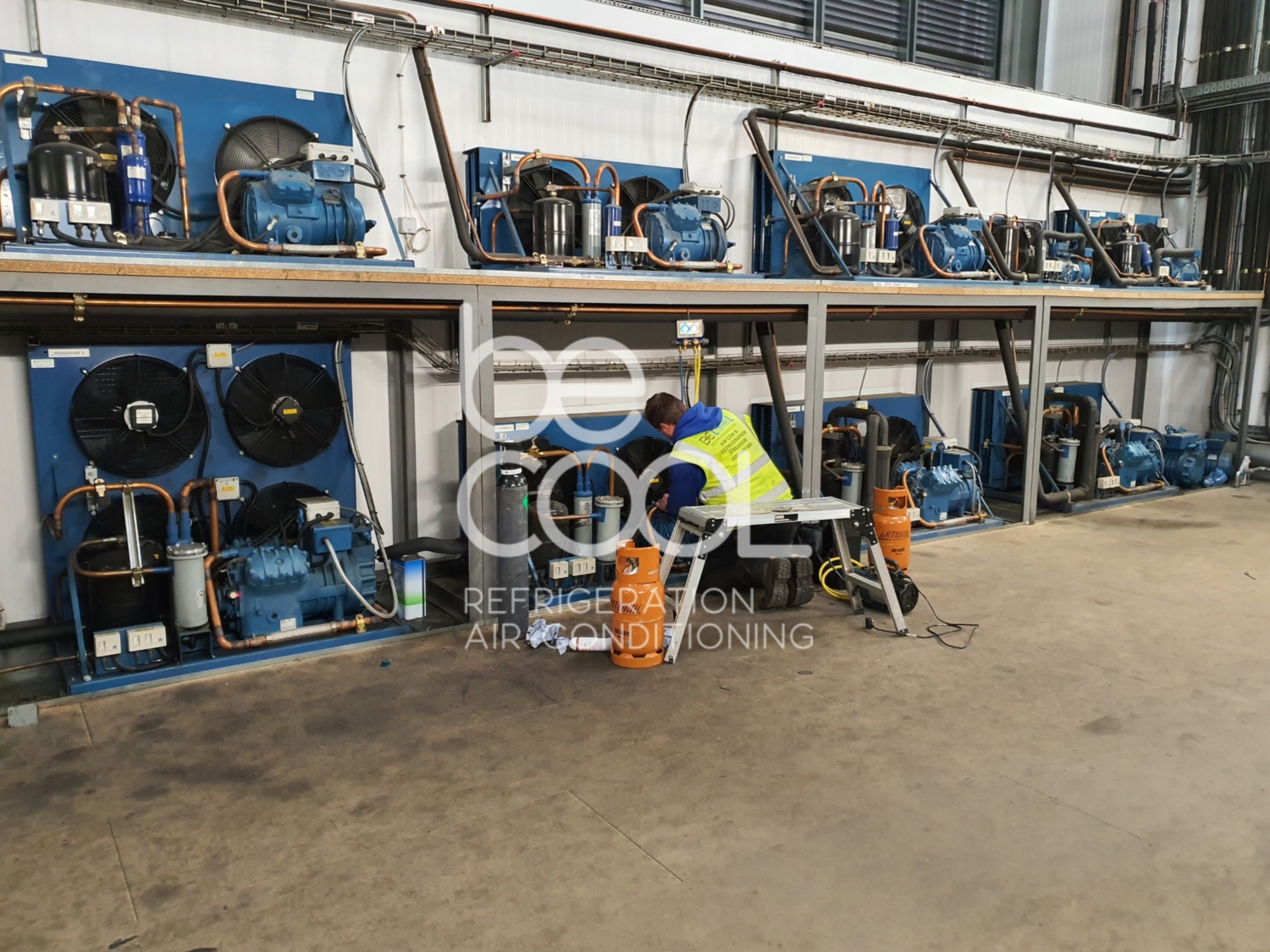
The worst cold store failure I have attended did not start with a compressor. It started with a strip curtain that had been driven through by a forklift eleven months earlier and never replaced. Warm, wet air poured into a freezer room every time the door opened. The evaporators iced up faster than the defrost cycle could clear them, ran longer to compensate, and the compressors were flat out for most of a summer. By the time anyone called us, the plant was failing for a reason nobody had thought to write down.
That is the pattern with refrigerated warehouses. The refrigeration rarely fails on its own. It fails because something around it has been quietly wrong for months, and at warehouse scale the cost of finding out late is measured in pallets.
Warehouse refrigeration and warehouse air conditioning are two different jobs
Worth separating these early, because they get conflated in tenders and they need different engineers.
Cold storage refrigeration holds product at a controlled temperature, typically 0°C to 5°C for chilled and around minus 18°C to minus 25°C for frozen. It runs continuously, it is sized for heat load from product, people and infiltration, and its failure mode is stock loss.
Warehouse air conditioning, or comfort and process cooling, is about the working space rather than the product. Picking areas with a lot of staff, mezzanine offices, battery charging rooms and increasingly automation and server racks that will not tolerate the ambient a warehouse naturally reaches in August. Its failure mode is people and equipment, not stock.
Plenty of sites need both, and the plant is often maintained under one contract by whoever won it. That works when the contractor genuinely holds both skill sets. It goes wrong when a comfort cooling engineer is sent to a transcritical pack, or when a refrigeration engineer treats a AC servicing visit as an afterthought at the end of a long day.
What a full maintenance visit should actually cover
A serious visit to a refrigerated warehouse covers the plant and the building, because the building is usually what is driving the plant.
- Compressors. Oil level and condition, suction and discharge pressures, superheat and subcooling, run hours against ambient, vibration, electrical connections and contactor wear.
- Evaporators. Coil condition, fin damage, fan motor current, defrost initiation and termination, drain pan and heated drain line clearance. A drain that freezes is a slow flood.
- Condensers. Cleaning, and an honest look at where they are sited. A condenser recirculating its own hot discharge air will never perform to its rating however clean it is.
- Refrigerant circuit. Leak detection, charge verification, insulation condition on suction lines, sight glass and filter drier state.
- Controls. Set points against what the site actually needs, alarm thresholds, sensor calibration, and whether the data logger is recording and anyone is reading it.
- The envelope. Door seals, strip curtains, dock shelters, panel joints, and floor condition. This is the section most contractors skip and it causes more failures than the rest combined.
On freezer stores add a check of the underfloor heating, if fitted. Sub-zero rooms sitting on an unheated slab can suffer frost heave, where ice forms in the ground beneath and lifts the floor. It is slow, expensive and largely irreversible once it has started.
Defrost strategy is where the energy goes
If a site is spending too much on refrigeration, defrost is the first place I would look, and it is almost never on the maintenance schedule as its own line item.
Every defrost cycle deliberately adds heat to a space you are paying to keep cold, then pays again to remove it. Too few cycles and the coil ices, airflow drops and the plant runs long. Too many and you are heating the room on a timer for no reason. Most warehouses are set on a fixed time schedule chosen at commissioning and never revisited, which means a store is defrosting the same number of times on a damp February morning as it does in a dry August week.
Demand defrost, triggered by coil temperature or pressure differential rather than a clock, addresses this directly. Combined with monitoring it is one of the few genuine efficiency measures in cold storage that does not involve replacing plant, which is part of why continuous data is worth having. We have written separately about what smart commercial refrigeration does and does not deliver on that front.
The compliance load on a UK cold store
Refrigerated warehouses sit under several overlapping regimes, and the operator carries the duty in most of them.
- F-Gas. Leak check frequency is set by the CO₂ equivalent of each circuit, and government guidance on checking F gas equipment for leaks states that "you must fit a leak detection system if your equipment contains F gas equivalent to 500 tonnes or more of carbon dioxide". Most warehouse pack systems are comfortably into that band. See the F-Gas rules for businesses for the detail.
- Food safety. Where you store food needing temperature control, Regulation 4 of the Food Safety (Temperature Control) Regulations 1995 is explicit that no person shall keep such food "at or in food premises at a temperature above 8°C". Your defence is the record, which is why temperature monitoring and HACCP matters as much as the plant.
- Cold working. Employers must manage the risks of prolonged work in low temperatures, covering clothing, rotation and break facilities. HSE guidance on workplace temperature sets out the duty.
- Ammonia plant. If you run R717, DSEAR applies alongside the refrigeration requirements, and the competence bar for anyone working on it is higher. HSE covers this under DSEAR.
A schedule that reflects how warehouses actually fail
| Interval | Focus | Why this interval |
|---|---|---|
| Monthly | Condenser cleanliness, door seals and curtains, alarm test, temperature log review for drift | These are the fast-moving failures, and all are visual or data checks that do not need the plant down |
| Quarterly | Full system inspection, pressures and superheat, electrical connections, defrost performance in the current season | Catches degradation before it compounds, and seasonally re-checks defrost against real conditions |
| Annually | Oil analysis, vibration testing, full sensor calibration, envelope and floor survey | The slow failures. Bearing wear and frost heave only show up over a long baseline |
Statutory leak checks sit on top of this at whatever frequency your charge dictates, and they are not a substitute for the servicing. Two different jobs that happen to be done by the same engineer on the same day.
What to look for in a contractor
Cold storage punishes generalists. A few things worth establishing before you sign anything.
Ask who actually attends out of hours, and whether they have been on your plant before. Ask how they handle a failure that needs the room emptied, because the plan for that should exist before it is needed rather than be invented at midnight. Ask whether the visit report will tell you what changed since last time or simply confirm that a list of checks was performed. A report that says everything was satisfactory for two years running is not reassurance, it is a sign nobody is looking hard.
Most of this ends up in how a refrigeration maintenance plan is written rather than in the price, which is why the cheapest schedule is rarely the one that stops you losing a room.
Frequently asked questions
How often should a refrigerated warehouse be serviced?
Quarterly full inspections with monthly visual and data checks suits most large cold stores, with an annual deep service. Sites running continuously or holding high-value stock often move to monthly attendance. Your F-Gas leak check frequency is set separately by the charge size and is a legal minimum, not a service interval.
What causes most refrigerated warehouse breakdowns?
In our experience the plant is usually the symptom. Air infiltration through failed doors and curtains, blocked or badly sited condensers, and defrost settings that no longer match conditions account for a large share of what gets reported as a compressor problem.
Is warehouse air conditioning covered by the same contract as cold storage?
It can be, and it should be priced and scoped separately within it. They are different systems with different failure consequences, and a contract that treats comfort cooling as an add-on to a refrigeration schedule usually under-serves it.
Do we need automatic leak detection?
If any single refrigerant circuit holds 500 tonnes CO₂e or more, yes, it is mandatory. Below that it is optional, though it reduces the required manual check frequency and gives you earlier warning of a loss that would otherwise show up as poor performance.
Scoping cover for a cold store
If you are reviewing maintenance across a refrigerated warehouse or a group of cold storage sites, it is worth walking the plant and the envelope together before the schedule is written, because the two are rarely separate problems. Our F-Gas certified engineers work on cold room installation and large cold storage maintenance across London and the South East, and we are happy to go through what your sites actually need.
About the author: Ali Elm runs Be Cool Refrigeration & Air Conditioning, a family-run London firm that has been installing, servicing and repairing commercial refrigeration and air conditioning since 2004. His F-Gas certified team has delivered more than 2,000 projects across London and the South East.
Last updated: 20 August 2026

Written by
Ali Elm
Ali is the Head of Operations at Be Cool Refrigeration with over a decade of hands-on experience in HVAC and commercial refrigeration. He oversees every installation, repair, and maintenance project, making sure the work meets the highest standards. Ali holds full F-Gas certification and has worked across residential, commercial, and industrial refrigeration systems throughout London and the South East. When he is not on site, he writes these guides to help business owners and homeowners understand their cooling systems better.