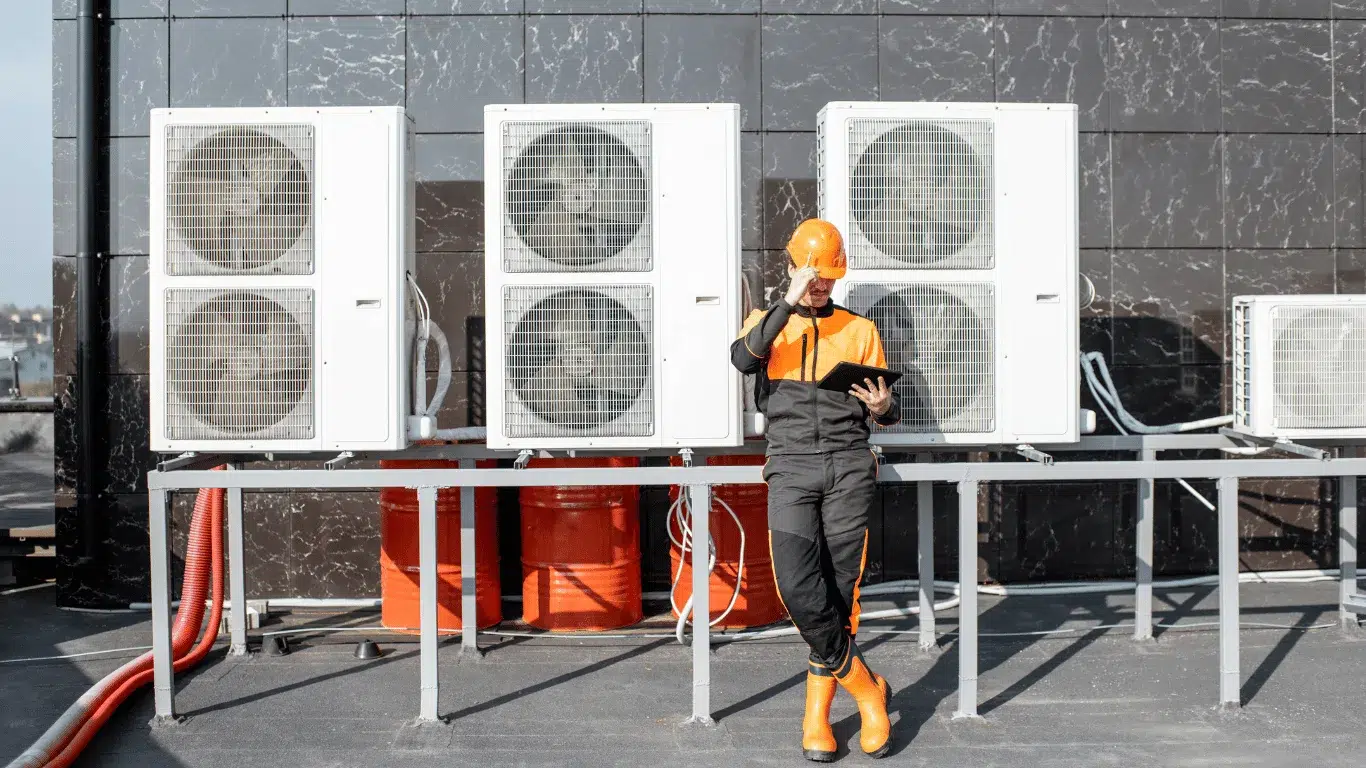
There is no single best commercial HVAC system in 2026. The best one is the type that fits the building: split or packaged units for smaller spaces, VRF heat recovery for multi-zone offices and hotels, chillers for large buildings, and an air handling unit wherever fresh air is needed, because cooling is not ventilation.
Most people asking this question have a building, a budget and a deadline, and somebody has already sent them a brochure. Brochures sell brands. What actually decides whether a system works is whether its type suits the layout, the occupancy and the hours the building runs. This page was rewritten for 2026 around that decision, using manufacturer documentation and government guidance rather than anyone's top-five list, ours included.
At a glance
| Building | System type usually considered | Why |
|---|---|---|
| Small office, shop, single room | Split or light commercial packaged system | Daikin describes its Sky Air range as ideal for smaller spaces, with separate controls for each unit |
| Multi-zone office, hotel, mixed tenancy | VRF/VRV with heat recovery | Simultaneous cooling and heating, recovering heat between zones |
| Medium to large building | Air-cooled or water-cooled chiller | Daikin lists both for medium-sized and large applications |
| Any occupied building | Air handling unit or other ventilation alongside the cooling | Air conditioning cools and heats air; ventilation brings fresh air in |
| Systems over 12kW | Plan for TM44 inspections | Inspections by an energy assessor, no more than five years apart |
Sources: Daikin UK, Sky Air and GOV.UK, A guide to air conditioning inspections in buildings
The main commercial HVAC system types
Every manufacturer has its own trade names, but commercial systems fall into a handful of families. The table below uses Daikin's UK product information because it publishes clear descriptions of each family. Other manufacturers make equivalents under their own names.
| System type | What the manufacturer says it is for | What it means for your building |
|---|---|---|
| Light commercial split (Daikin Sky Air) | "Customisable for any small to medium-sized commercial application"; ideal for smaller offices, with separate controls for each unit | Simple to install and maintain, one indoor unit or a small group per outdoor unit |
| VRF heat recovery (Daikin VRV 5 Heat Recovery) | "3-pipe heat recovery recovering and recirculating heat"; "Simultaneous cooling and heating" | Lets a south-facing meeting room cool while a north-facing office heats, on one system |
| Air-cooled chiller | Ideal for medium-sized and large applications; outdoor installation | Chilled water piped to fan coils or air handling units around the building |
| Water-cooled chiller | Ideal for medium-sized and large applications; indoor installation | Rejects heat through a water circuit, for example to a cooling tower, which brings its own duties |
| Air handling unit | Ventilation "directly impacting health, safety, comfort, efficiency, and regulatory compliance" | Brings in and conditions fresh air; can be paired with a VRF or condensing unit |
Sources: Daikin UK product pages for VRV 5 Heat Recovery, chillers and air handling units
The water-cooled chiller row deserves a warning. Wet cooling towers and evaporative condensers must be notified to the local authority under the Notification of Cooling Towers and Evaporative Condensers Regulations 1992, a duty a dry split or VRF system does not carry. The cheapest plant on paper is not always the cheapest to run. If you are comparing types, our guide to VRF air conditioning goes deeper on the multi-zone option, and split vs cassette covers the smaller end.
Three questions that decide it
How many zones, and do they want different things at the same time?
One open-plan floor with one tenant is a different job from a hotel where half the rooms want heat and half want cooling on the same April afternoon. Heat recovery VRF exists for the second case. For the first, it can be more system than you need.
Where can the plant go?
Roof space, a rear yard, a plant room, or none of the above. A listed building or a conservation area changes the answer again, and outdoor units in general raise planning questions, which our post on planning permission for air conditioning covers.
What will it cost to keep legal?
Every system type carries the same baseline duties under F gas rules, and larger systems add inspection duties. Those costs run for the life of the plant, so they belong in the comparison from the start.
The compliance side, in one table
None of these rules picks a system for you, but each one shapes the choice. The single split ban in particular changes what can be installed new.
| Rule | What it says | Who it affects |
|---|---|---|
| F gas ban on new single split systems | "Single split" systems containing less than 3kg of refrigerant (one cooling coil connected to a remote condensing unit) using F gases with a GWP above 750 are banned from 2025 | Anyone buying a new small split; larger systems such as chillers or larger splits are listed as an exception |
| F gas leak checks | At least every 12 months for 5 to less than 50 tonnes CO2 equivalent, every 6 months for 50 to less than 500, automatic leak detection at 500 or more | The operator of the equipment |
| Qualified technicians | "You must have your own qualifications to work on equipment containing F gas, even if you work for someone else" | Whoever installs, services or repairs the system |
| Air conditioning inspections (TM44) | Systems with an effective rated output of more than 12kW must be inspected by an energy assessor, no more than five years apart | Building owners and managers in England and Wales |
| Workplace temperature | No law sets a maximum, but employers must keep the temperature at a comfortable level and provide clean and fresh air; the indoor minimum should normally be at least 16°C, or 13°C for rigorous physical work | Employers |
Sources: GOV.UK, Bans on F gas in new products and equipment; GOV.UK, Checking F gas equipment for leaks; GOV.UK, Qualifications to work with F gas; GOV.UK, A guide to air conditioning inspections; HSE, Temperature in the workplace
Two of those land on the building owner rather than the installer. The TM44 inspection report has to be commissioned and kept, and the government guide notes that Trading Standards can issue a penalty charge notice if it is not. Our TM44 inspections guide explains what the inspection involves.
What "best" should mean in 2026
Ask three things of any proposal. Does the system type match how the building is actually used, zone by zone and hour by hour? Does it come with fresh air, or does it assume the windows will do that job? And what will it cost to service, leak check and inspect for the next ten years, as well as to install? A proposal that answers all three clearly is worth more than one that leads with a brand name.
It is also worth asking which refrigerant the system uses and why. Daikin, for example, says its VRV 5 range is "specifically built for lower GWP refrigerant R-32". Our R32 refrigerant guide explains what that means for servicing and for the rules above.
When to get help
If you are weighing up options for a new building, a refit or a replacement, a site survey answers most of the questions above. Be Cool has installed and serviced commercial air conditioning across London and the South East since 2004, with F-Gas certified engineers and more than 2,000 projects behind us. Our commercial air conditioning installation team can survey the building and talk you through the realistic options.
Frequently asked questions
What is the most common commercial HVAC system?
It depends on the size of the building. Small premises often use split or light commercial systems, multi-zone buildings often use VRF, and large buildings often use chillers with air handling units. Ask for the reasoning behind any recommendation.
Is VRF better than a chiller?
Neither is better in general. Daikin positions VRF heat recovery for simultaneous heating and cooling across zones, and its chillers for medium-sized and large applications. The building decides.
Can I still install a small split air conditioner in 2026?
Yes, but new single split systems under 3kg must not use an F gas with a GWP above 750, under the ban that applies from 2025. In practice that rules out R410A in new small splits.
Does commercial air conditioning need an inspection?
Systems with an effective rated output of more than 12kW must be inspected by an energy assessor at least every five years in England and Wales, alongside F gas leak checks where they apply.
Does air conditioning count as ventilation?
Not on its own. A split or VRF indoor unit conditions the air already in the room. HSE lists providing clean and fresh air as a separate duty, which is why ventilation, such as an air handling unit, needs planning alongside the cooling.
Choose the type first, the brand second
Get the system type right and most reputable brands will do the job well. Get it wrong and no brand will rescue it. Start from how the building is used, price the compliance as well as the kit, and make sure fresh air is part of the plan rather than an afterthought.
About the author: Ali Elm runs Be Cool Refrigeration & Air Conditioning, a family-run London firm that has been installing, servicing and repairing commercial refrigeration and air conditioning since 2004. His F-Gas certified team has delivered more than 2,000 projects across London and the South East.
Last updated: 2 November 2026

Written by
Ali Elm
Ali is the Head of Operations at Be Cool Refrigeration with over a decade of hands-on experience in HVAC and commercial refrigeration. He oversees every installation, repair, and maintenance project, making sure the work meets the highest standards. Ali holds full F-Gas certification and has worked across residential, commercial, and industrial refrigeration systems throughout London and the South East. When he is not on site, he writes these guides to help business owners and homeowners understand their cooling systems better.